Gostockup project · May – June 2026 · prototype
Seasonal rewards program
How I came up with and worked out a loyalty program for a grocery store: from the idea to a spec and a working prototype.
A typical loyalty program works like this: you buy, get a discount, and forget about it until the next order. I wanted customers to have a reason to come back, and for every purchase to add up to something.
For a grocery store, repeat purchases matter more than one big order. Someone who comes back every two weeks brings in more over a year than someone who bought a lot once. Everyone has discounts and promo codes, and customers take the percentage and leave. That doesn’t build any connection with the store.
The idea
A video game mechanic, for groceries
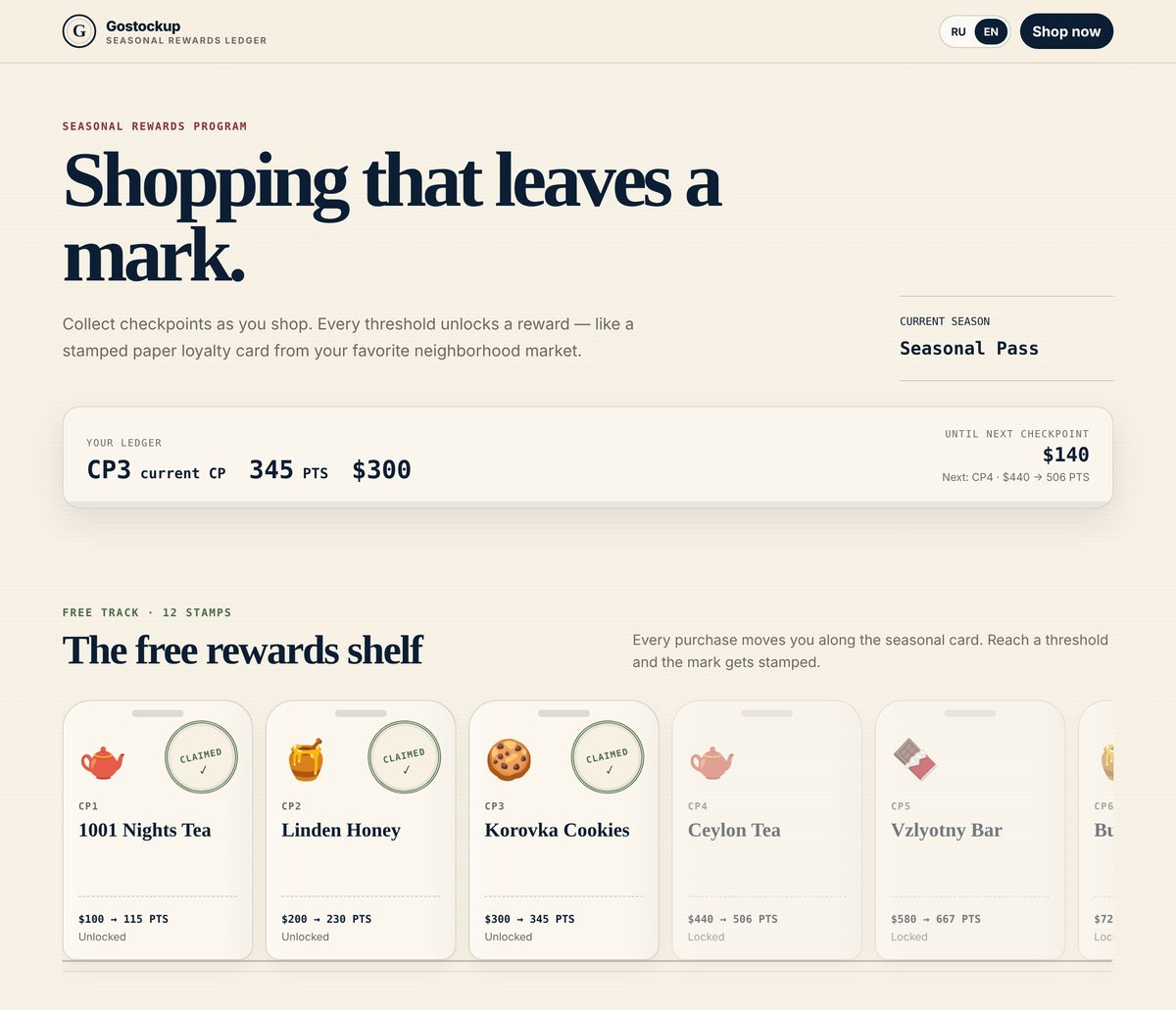
Games have a season pass: players see their progress, get a reward at each checkpoint and want to unlock the next one. I took that principle to everyday shopping. Every purchase moves the customer along a seasonal map, and each checkpoint unlocks a gift from our own assortment.
It feels closer to a paper loyalty card at a favorite corner shop, stamped with every visit. The difference is that customers always see how far they are from the next gift.
How it works
The program rules
It has to make sense in ten seconds, or customers won’t bother.
12 checkpoints
Checkpoints unlock by total spend in the season. When the season ends, progress starts over.
Dollars into points
Purchases convert into points at a fixed rate. Customers see one simple scale.
Gifts from the assortment
Each checkpoint gives a gift from the assortment. It costs the store its cost price.
Two reward tracks
A free one for everyone and a separate one for different customer groups.
Economics and operations
What I worked out before the prototype
A nice mechanic is easy to come up with. The hard part is making it pay off without breaking the warehouse or support.
Money
- Checkpoints
- What each checkpoint costs the store under different shopping patterns, from rare orders to frequent ones.
- Gifts
- The cost of each gift and the total budget for a season.
- Returns
- What happens to progress and an already issued gift when a customer returns an order.
Operations
- Shopify
- Where and how to store a customer’s progress so the site, the register and support can all see it.
- Warehouse
- How a gift gets picked together with the order, with no manual notes.
- Support
- How to answer “where is my gift” and “why didn’t my purchase count”.
Prototype
Clear without explanations
I put the prototype together with tools so the scenarios could be shown live. It shows how many points a customer has, which gifts are claimed and how far the next one is.
Visually I kept to the feel of a corner grocery: warm colors, a paper card, a “claimed” stamp. The game mechanic runs underneath, but it all looks like a familiar store.
Two language versions: Russian and English
Status
Ready for a launch decision
The concept, a spec with rules and economics, and the prototype are ready. The owners decide on launch and timing, so there are no revenue results here.
If we launch, I’ll watch three numbers: the repeat purchase rate among members, how often they order compared to everyone else, and the cost of gifts per order.
The fastest way to reach me is LinkedIn
My full career and notes on the work are there too